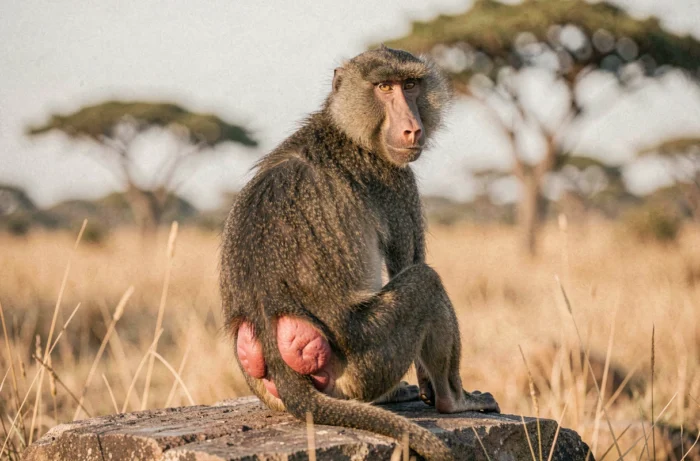
The red coloration of the buttock callosities in baboons is based on a precise vascular mechanism, linked to the density of blood capillaries in a dermis devoid of melanin and fur. It is neither a pigment deposited in the epidermis nor an inflammatory reaction: it is a skin window onto the underlying vascular network.
Vascular Mechanism and Histology of the Baboon’s Buttock Callosity
The ischial callosities, these patches of bare skin located at the level of the ischial tuberosities, exhibit a unique histological architecture. The epidermis is thickened and keratinized, but the underlying dermal layer is traversed by a dense capillary network, abnormally superficial compared to the rest of the integument.
The complete absence of hair follicles and the low concentration of melanocytes allow the oxygenated hemoglobin circulating in these capillaries to show through. The red hue results directly from local vasodilation modulated by steroid hormones, particularly estrogen in females and testosterone in males.
We observe that the intensity of the redness varies within a few days in the same individual, which excludes a classic pigmentary mechanism. In females during the follicular phase, the increase in estradiol levels causes a blood influx that engorges the dermal capillaries and turns the callosity a bright red, sometimes purplish. It is a reversible and cyclical process.
To better understand why the baboon has a red bottom, one must also consider the structure of dermal collagen in this area, which acts as an optical diffuser amplifying the visibility of the vascular coloration.
Sexual Signal in Female Baboons: Ovulation and Perineal Tumescence
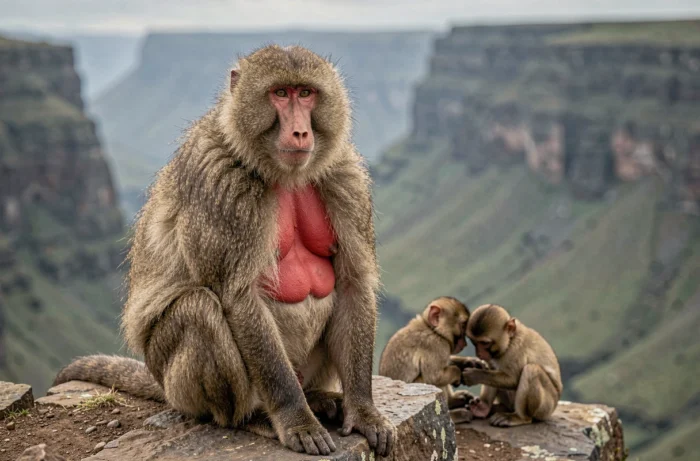
In females of many baboon species (Papio anubis, Papio cynocephalus), the ano-genital area undergoes spectacular tumescence at the time of ovulation. This tumescence corresponds to water retention in the perineal connective tissues, directly influenced by the peak of estradiol.
The swelling is accompanied by an intensification of redness. Males use this visual combination as a reliable indicator of the ovulation moment. Studies on phylogenetically close Japanese macaques confirm that the red coloration significantly correlates with the fertile period.
This signal is not binary. Its intensity varies from one cycle to another in the same female, and from one female to another within the same group. Dominant males preferentially direct their copulation attempts towards females exhibiting maximum tumescence and redness, suggesting active sexual selection on this trait.
Differences Between Baboon Species
Not all species of the genus Papio exhibit the same degree of tumescence. The hamadryas baboon (Papio hamadryas) shows less pronounced perineal tumescence than the olive baboon. In hamadryas, the reduced harem social structure may lessen the selection pressure on this visual signal, as competition among females to attract males is mitigated by the guarding system exercised by the leading male.
Buttock Redness as a Quality Indicator in Male Baboons
The redness of the callosities is not exclusively a female signal. Recent work on Guinea baboons shows that the red coloration of bare areas in males is now being tested as a physical quality signal in sexual selection. Researchers have evaluated whether behaviors such as bringing meat influence female choice, concluding that this behavior proves to be irrelevant.
On the other hand, females may rely more on bodily signals, and the authors explicitly cite the redder patches on the buttocks as traits likely indicating male quality. This conclusion aligns with what is documented in other sexually red-colored primates, such as geladas and mandrills.
- In mandrills, facial and genital redness correlates with hierarchical rank and testosterone levels, establishing a direct link between social status and chromatic intensity.
- In geladas, the red chest patch signals the male’s physical condition and reproductive potential to females in the group.
- In Guinea baboons, red bodily signals seem more reliable than prosocial behaviors for assessing partner quality.
We thus move from a view where red bottoms served solely as indicators of female sexual receptivity to a more comprehensive model where redness functions as a bidirectional quality signal, utilized by both sexes.
Trichromatic Vision in Primates and Perception of the Red Signal
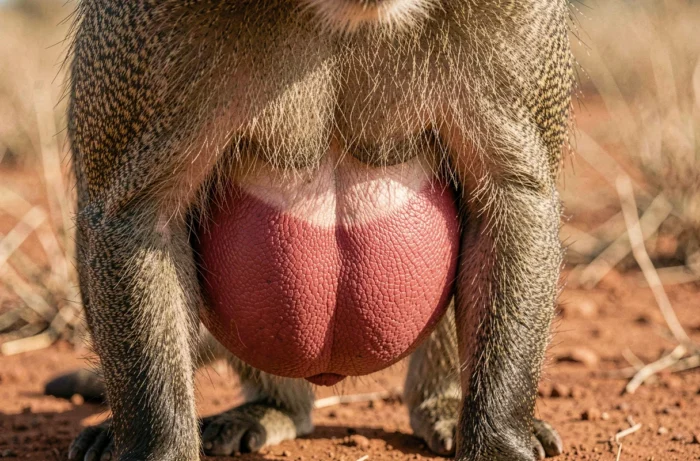
An often-overlooked aspect in popular articles concerns the co-evolution between the red signal and the visual system of catarrhine primates. Baboons, like all Old World monkeys, possess a trichromatic vision with fine discrimination in the red-green spectrum.
This visual ability, absent in most mammals (which are dichromatic), allows baboons to perceive subtle variations in redness that other animals would not detect. Selection pressure has thus acted simultaneously on two fronts: the emitter (the vascularized skin) and the receiver (the visual system).
Research from Nagoya Institute of Technology has identified molecular bases for red-green vision in primates, confirming that the opsins responsible for chromatic discrimination in the long spectrum were selected early in the catarrhine lineage.
A Costly Signal to Maintain
Skin redness is an honest signal in the sense of Zahavi’s handicap theory. Maintaining intense dermal vascularization in an exposed area represents a real metabolic and immune cost. A parasitized individual or one in poor physical condition sees its redness diminish, making the signal difficult to falsify.
This property explains the evolutionary robustness of the trait: a costly signal correlated with physical condition resists cheating. Baboons with the reddest callosities signal, without the possibility of bluffing, good vascular health, high hormonal status, and low parasitic load.
Thus, the baboon’s buttock redness concentrates multiple layers of biological information into a single morphological trait. It provides insights into the reproductive cycle, physical condition, hierarchical status, and genetic quality of the individual bearing it, all instantly readable thanks to a visual system calibrated for this spectrum.