A quality shoe relies on three technical parameters: the construction of the sole, the choice of upper material, and the geometry of the fit. These three elements alone determine the comfort experienced, the longevity of the pair, and its ability to integrate into a daily wardrobe. Understanding their interaction allows for an informed choice, far from fashion trends.
Sole Construction: cushioning, flex, and wear
The sole is the part that undergoes the most mechanical stress. It is composed of three distinct layers: the outsole (or wear layer), the midsole, and the insole (or footbed).
The outsole determines grip and abrasion resistance. Natural rubber provides good traction on wet surfaces, while synthetic rubber (TPR) is more resistant to wear on asphalt. A solid rubber outsole will be easier to resole than a foam-injected sole, which extends the lifespan of the pair.
The midsole manages cushioning. Lightweight EVA foams lose their absorption capacity after several hundred kilometers. Polyurethane, being denser, retains its properties longer but adds weight to the shoe. For everyday urban use, the compromise often lies in a medium-density PU foam.
The insole, often overlooked, deserves special attention. A removable insole allows for the insertion of an orthotic insole or simply for replacement when it flattens, without changing the entire pair. This is a concrete durability criterion that is rarely highlighted.
To explore models that incorporate these technical characteristics, a useful resource is: https://grainedeshoes.com/, which offers pairs designed for daily use.
Upper Materials: leather, technical textiles, and breathability
The upper material (the top part of the shoe) determines three things: breathability, adaptability to the foot, and aesthetic aging.
Full-grain leather remains the material that ages best. It develops a patina, nourishes, and repairs. Well-maintained leather becomes more supple over time and gradually conforms to the foot’s shape. Nubuck, the sanded version of leather, offers a softer touch but requires more regular maintenance against stains.
Technical textiles (mesh, knit) dominate the sneaker segment. Their advantage: superior breathability compared to leather and reduced weight. Their limitation: they deform more quickly under stress and do not hold up well to repairs. A torn mesh is difficult to replace, whereas a scratched leather can be restored by a cobbler.
Inner Lining and Moisture Management
The lining plays a direct role in thermal comfort. A leather lining wicks moisture better than a synthetic lining, reducing friction and limiting irritation. For closed shoes worn all day, this is a criterion that makes a tangible difference from the first hour of wear.
Fit Geometry: width, volume, and foot support
The fit refers to the internal shape of the shoe that accommodates the foot. Two pairs of the same size can offer radically different comfort depending on their fit.
- The width of the forefoot should allow the toes to spread naturally while walking. A forefoot that is too narrow compresses the metatarsals and promotes long-term deformities (hallux valgus, corns).
- The volume at the instep determines support without excessive tightness. An adjustable closure system (laces, buckles, Velcro) compensates for variations in foot volume throughout the day, related to natural swelling.
- The height of the arch varies according to foot shapes. A flat shoe without arch support is suitable for flexible flat feet but causes quick fatigue in high-arched feet that need midfoot support.
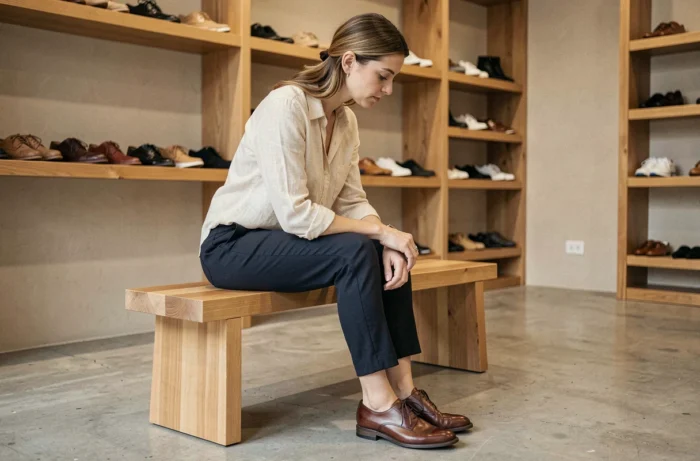
Trying on shoes at the end of the day allows you to test the fit when the foot is at its maximum volume. If the pair is comfortable at this time, it will be comfortable all day long.
Durability and Repairability: what extends the life of a pair of shoes
The durability of a shoe is not just about the robustness of its materials. It also depends on its ability to be repaired.
In France, the Refashion Repair Bonus allows for a reduction in the bill at a certified cobbler. This scheme covers resoling, with an amount deducted directly from the repair price. Before purchasing, check two things: can the pair be resoled (glued sole vs. stitched) and is there a certified repairer nearby.
Shoes with stitched construction (Goodyear, Blake, Norwegian) are better suited for repair than glued constructions. The higher initial cost is offset by a lifespan that can double or even triple. A pair that is resoled twice costs less over ten years than a new pair bought every two years.
Regular Maintenance and Its Impact on Longevity
Some simple actions significantly extend the lifespan:
- Use cedar shoe trees after each wear to absorb moisture and maintain the shape of the leather.
- Alternate between two pairs daily to allow each shoe to dry for at least twenty-four hours between uses.
- Condition the leather with an appropriate polish or cream every ten to fifteen wears, depending on exposure to the elements.
The European regulatory framework (ESPR) ultimately provides for durability and repairability requirements by product category, but shoes are not yet among the priority categories. A specific study is announced for the end of 2027. In the meantime, the choice of repairable materials remains the best guarantee of durability.
Choosing a pair of shoes for everyday wear involves balancing three technical constraints that do not necessarily oppose each other. A resolable sole, well-lined full-grain leather, and a fit adapted to one’s morphology form a foundation that lasts over time, without sacrificing style. The rest is a matter of personal style.