
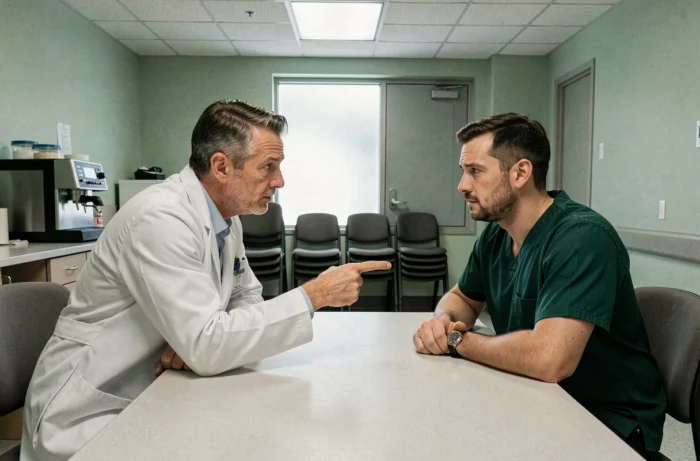
A vicious attitude in the healthcare professional environment refers to a repeated, often subtle behavior that degrades the working conditions of one or more colleagues. Devaluing remarks in team meetings, withholding clinical information, exclusion during handovers: these actions fall under internal violence among professionals, a legally distinct category from assaults committed by patients or their relatives.
The national interprofessional agreement of March 26, 2010, which transposes the European framework agreement of April 26, 2007, precisely describes these forms of violence between colleagues or with the hierarchy.
Internal violence in healthcare institutions: a statistical gray area
The competitors of this article almost exclusively address external violence, that of patients towards caregivers. Vicious attitudes among professionals remain a blind spot.
Despite the legal framework established by the interprofessional agreement of 2010, no national statistics record cases of moral harassment recognized by a judge in a hospital setting. The number of formally acknowledged professional burnouts by institutions is not consolidated either. This lack of data creates a paradox: the texts clearly define the prohibited behaviors, but their measurement remains invisible at the system level.
Several resources document these vicious attitudes on Relais Santé, distinguishing the mechanisms specific to the hospital sector from those observed in other work environments. The specificity of care (emergency, vital responsibility, marked medical hierarchy) encourages the trivialization of certain behaviors that other sectors would immediately classify as harassment.
Identifying a toxic attitude: factual criteria and warning signals
A one-time behavior, even if unpleasant, does not constitute a vicious attitude. The determining criterion is repetition. French labor law requires repeated actions that have the object or effect of degrading working conditions.
Common forms in care services
Some behaviors easily go under the radar in a high-pressure department. Nevertheless, they are documented by recent case law.
- Withholding clinical information: a colleague systematically fails to communicate elements during handovers, putting the next team in difficulty with the patient.
- Management by terror: a manager uses schedules, shift assignments, or evaluations as personal pressure tools rather than as organizational tools.
- Progressive isolation: a professional is excluded from team meetings, internal training, or collective decisions without justification related to their competencies.
- Repeated devaluing remarks in front of patients or families, which undermine both the targeted caregiver’s credibility and the perceived quality of care.
Differentiating service pressure from deliberate behavior
Work overload generates legitimate tensions. A harsh tone during an emergency does not carry the same meaning as recurrent humiliation in medical staff. The targeted and repeated nature distinguishes the vicious attitude from collective stress. When a single team member systematically bears the brunt of criticism or unpleasant tasks, the likelihood of deliberate behavior increases.
Recent legal framework: what case law imposes on employers
The Court of Cassation has recently strengthened employers’ obligations regarding moral harassment. It now requires a comprehensive examination of the facts presented by the employee, rather than an isolated analysis of each incident. An institution that dismisses actions one by one, judging them individually as benign, exposes itself to judicial reclassification.
This jurisprudential evolution changes the game for healthcare services. An unfavorable schedule taken alone seems trivial. Combined with exclusion from handovers and repeated remarks, it constitutes a pattern that the judge must assess as a whole.
Moreover, a requirement for internal investigation in cases of reported sexist and sexual violence is emerging in recent texts. Healthcare institutions, where various statuses coexist (hospital practitioners, contractual workers, temporary staff, freelancers), will need to structure procedures adapted to this diversity.

Preventing vicious attitudes: concrete mechanisms in institutions
Identifying a behavior is not enough. Prevention relies on organizational measures, not just individual vigilance.
Traceability of reports
An internal reporting register, distinct from the register of adverse events related to care, allows for documenting facts with dates, witnesses, and factual descriptions. Without a timestamped written record, proving moral harassment becomes extremely difficult.
Role of the work collective
Teams that conduct regular debriefings after tense situations identify relational deviations earlier. These exchange times do not replace a formal procedure, but they create a space where naming a problematic behavior becomes possible before it becomes chronic.
- Formalize speaking times in the team, facilitated by a third party (work psychologist, mediator), at least once a quarter.
- Incorporate a question about work relationships within the service into annual reviews, not just about care objectives.
- Train frontline managers to distinguish between legitimate authority and abusive managerial practices, a point rarely addressed in healthcare management curricula.
Preventing psychosocial risks in the healthcare sector suffers from a gap between available texts and their concrete application in services. The interprofessional agreement of 2010 provides a framework, case law clarifies it, but the implementation of operational measures remains the responsibility of each institution, with very unequal means and levels of maturity.