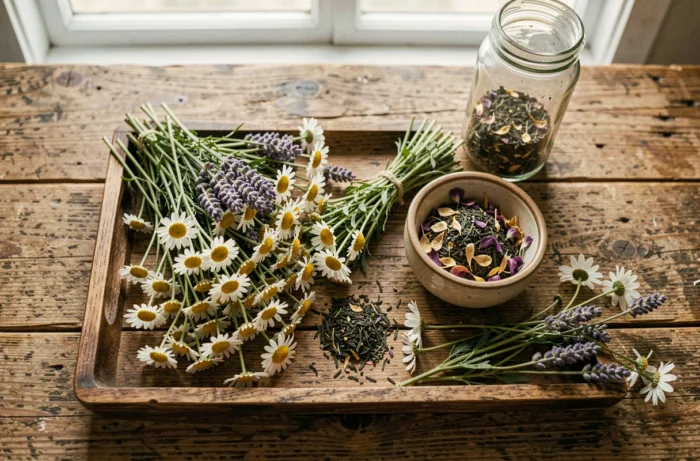
An organic flower used in infusion is a flower grown according to European regulation (EU) 2018/848, without synthetic pesticides or chemical fertilizers, and controlled by an accredited certifying body. This regulatory distinction directly affects the quality of the resulting brew: residues, aromatic profile, traceability. Understanding this framework allows one to differentiate between a truly organic flower and a product whose label plays on ambiguity.
Organic certification of flowers for infusion: what European regulation requires
The term “organic” applied to a flower intended for infusion is not just a marketing argument. Its use is reserved for operators controlled according to regulation (EU) 2018/848, which governs the production, processing, and labeling of organic products in the European Union.
Terms like “natural,” “pesticide-free,” or “ecological” do not replace this certification. They do not involve any control by an independent third party and can be misleading. A chamomile flower labeled “natural” may very well have been treated with plant protection products allowed in conventional agriculture.
For a flower to bear the European organic logo (the starry leaf), the entire chain, from producer to packager, must be certified. This includes traceability of batches, the absence of mixing with non-organic flowers, and regular audits. Several French tea houses source from certified supply chains and offer flowers on Le Jardin de Gaïa in ranges where each batch meets these specifications.
Pesticide residues in infusion plants: an underestimated issue
Dried flowers for herbal tea do not undergo intensive washing before consumption. Hot water directly extracts what the plant contains, including any potential chemical residues. This method of preparation makes the quality of the raw material more critical than for other processed foods.
The maximum residue limits (MRLs) applicable to imported infusion products continue to evolve. Health Canada, for example, has proposed new limits for tea regarding chlorantraniliprole, following an evaluation of imported products. The European Union also regularly tightens its thresholds for several substances.
Choosing organic flowers significantly reduces exposure to these residues. Organic certification prohibits nearly all synthetic pesticides and imposes analytical controls on batches. For a herbal tea of lime flowers, lavender, or hibiscus, this guarantee directly impacts what ends up in the cup.
Aromatic profile of organic flowers: how cultivation influences flavor
A flower grown in organic agriculture generally develops in soil richer in microorganisms. The absence of chemical inputs encourages the plant to produce more secondary metabolites to defend itself against pests. Among these compounds are important oils responsible for aroma.
This mechanism explains why some organic flowers have a more pronounced olfactory profile than their conventional counterparts. A Damascus rose grown without synthetic treatment develops terpenes and aromatic alcohols in higher concentrations, resulting in a more fragrant infusion.
The harvest also plays a crucial role. Flowers intended for organic infusion are often hand-picked at the right stage of blooming to preserve the freshness of volatile compounds. Low-temperature drying, common in certified artisanal supply chains, complements this preservation. The method of cultivation and processing shapes the aromatic quality as much as the chosen variety.
Organic flowers in tea and herbal tea: how to read the label
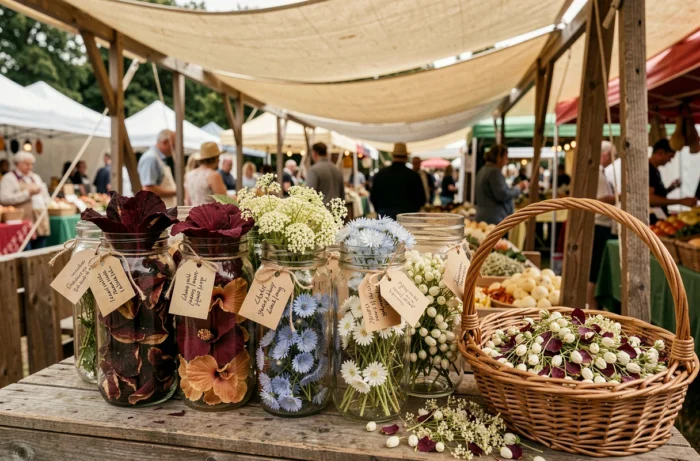
The distinction between flower tea and flower herbal tea deserves to be clearly stated. A flower-flavored tea (green, black, white) contains caffeine from Camellia sinensis. A pure flower herbal tea, such as chamomile or cornflower, does not contain any.
On the label, several elements allow for evaluating the quality of a blend:
- The list of ingredients, ranked in descending order by weight: if “flavor” appears before the name of the flower, the product relies more on an added fragrance than on the plant itself.
- The mention of the European organic logo and the certifying body number (FR-BIO-XX): these two elements must appear together to guarantee compliance with the regulation.
- The geographical origin of the plants: a precise indication (region, country) often translates to better traceability than a vague “blend of plants from EU/non-EU origin.”
Quality blends favor whole flowers or large pieces rather than powders or debris. A whole flower gradually releases its aromas in hot water, offering more nuanced flavors and a visually more appealing infusion.
Which organic flowers to choose for starting with infusion
Not all edible flowers lend themselves to infusion with the same success. Some offer an accessible taste profile and recognized qualities in traditional herbal medicine:
- Chamomile, with sweet and slightly honeyed notes, appreciated for its soothing properties on digestion.
- Hibiscus (bissap), whose fruity acidity and intense red color make it an ideal base for summer herbal teas, hot or iced.
- Lime, a classic for evening infusions, which develops subtle floral aromas and a slightly creamy texture in the mouth.
- Lavender, to be used sparingly: a few flowers are enough to scent a blend without making it soapy.
These aromatic plants can easily be found in certified organic versions at herbal shops and specialized tea houses. Starting with simple flowers, infused alone, allows for recognizing their profile before attempting blends.
The infusion temperature is as important as the quality of the flower. Most organic flowers infuse between 85 and 95 °C for five to ten minutes. Water that is too hot destroys the most fragile aromatic compounds and gives unnecessary bitterness. A kitchen thermometer is sufficient for precision, without expensive equipment.