
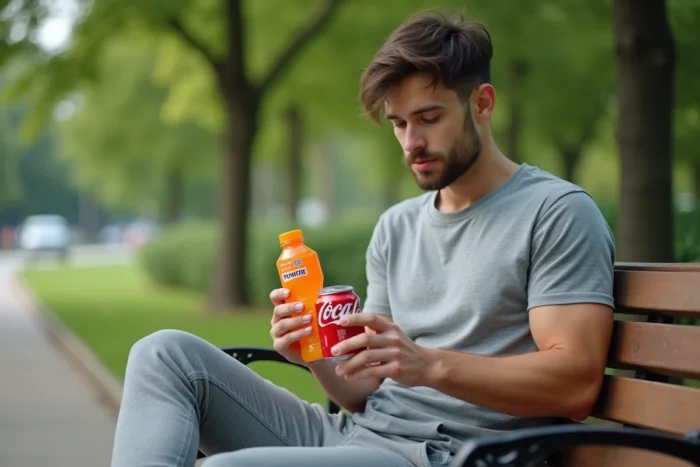
We are in the middle of a match, it’s hot, and someone pulls a bottle of Coca-Cola out of the cooler bag. Next to them, a teammate is drinking Powerade. Both drinks belong to the same industrial group, but their composition has almost nothing in common. What separates them is not the taste or the color: it’s their sugar content, their electrolytes, and especially the context in which they are consumed.
Sugar and calories: what the label says about Powerade and Coca-Cola
The first instinct when comparing two drinks is to turn the bottle around. Classic Coca-Cola shows about 10.6 g of sugars and 42 kcal per 100 ml. A lemon-flavored isotonic Powerade sold in supermarkets in France contains around 4 to 5 g of sugars and 18 to 21 kcal per 100 ml.
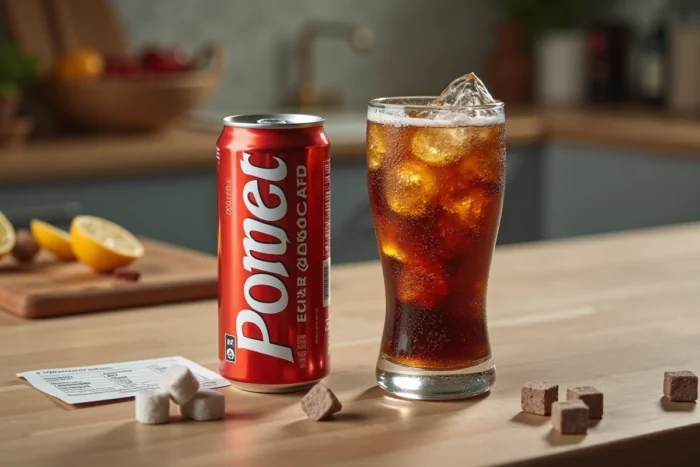
At equal volume, Coca-Cola contains more than double the sugar compared to a standard Powerade. In a 500 ml bottle, the gap widens even further: it goes from about 25 g of sugars for Powerade to over 50 g for Coca. In a football match, finishing a bottle of soda is equivalent to consuming ten sugar cubes, with no functional benefit for the effort.
When looking for a detailed Powerade vs Coca-Cola comparison, it is often this caloric imbalance that stands out first, and rightly so.
Electrolytes and sodium: Powerade versus the nutritional void of Coca-Cola
Sugar is only part of the problem. What really distinguishes an isotonic drink from a soda is the presence of electrolytes: sodium, potassium, and sometimes magnesium.
Powerade contains sodium and potassium in calibrated amounts to compensate for losses related to sweating. Coca-Cola, on the other hand, provides neither sodium nor potassium in significant quantities. In prolonged effort situations (beyond 60 minutes), this absence makes all the difference.
Why sodium matters during exertion
When we sweat, we lose salt. Without sodium intake, the body struggles to retain the water consumed. One can drink a lot and still be poorly hydrated. An isotonic drink like Powerade, even if imperfect, addresses this constraint. Coca-Cola, on the other hand, functions like sweetened sparkling water without any rehydration function.
Outside of sports, neither of these drinks replaces water. But if one must choose between the two during training or a match, Powerade serves a function that Coca-Cola does not.
Low-calorie Powerade ranges: an unknown option
In France, there are low-calorie versions of Powerade formulated with sweeteners like aspartame or acesulfame-K, showing about 18 kcal per 100 ml. In other markets, Powerade Zero versions exist with zero calories, zero sugar, while still providing sodium and potassium.
These ranges remain little visible on shelves, often overshadowed by the classic formats. Feedback varies on this point: some athletes find the taste of the sweetened versions less pleasant during exertion, while others perceive no difference. What matters is that the zero-sugar option retains the electrolyte content, unlike Coca-Cola Zero, which removes sugar but adds nothing to compensate for sweat.
What Coca-Cola Zero does not do
Coca-Cola Zero eliminates sugar and calories, making it a less problematic choice for daily consumption. But it remains devoid of electrolytes. For someone hydrating during exertion, choosing a Coca Zero amounts to drinking a flavored beverage without any sports function.
Powerade in daily life: a sports drink not meant for the table
It would be wrong to conclude that Powerade is “good for health” in general. Outside of a physical activity context, drinking an isotonic drink is not useful. The added sodium, useful during exertion, becomes unnecessary at rest. The sugars, even in moderate amounts, add to the daily caloric intake without benefit.
- During an effort of more than 60 minutes: Powerade provides sugars, sodium, and potassium to maintain hydration and energy. That’s its domain.
- At rest or in the office: plain water remains the only drink the body needs. Neither Powerade nor Coca-Cola can replace it.
- In immediate recovery after exertion: an isotonic drink can help restore lost electrolytes, whereas a soda provides sugar without mineral compensation.
The context of consumption determines the choice, not the brand. A Powerade consumed in front of the television is no better than a Coca-Cola. A Coca-Cola consumed at halftime during a match does not replace a drink formulated for exertion.
Nutritional quality of Powerade: the limits to know
Powerade is among the isotonic drinks rated the lowest by sports dietitians. Several sports nutrition professionals point out a composition considered basic compared to other brands on the market, including:
- An absence of vitamin B1 in certain formulations, whereas French regulations require this intake for a drink to be classified as energetic in the strict sense.
- An imbalanced carbohydrate/sodium ratio compared to recommendations for long efforts.
- The absence of BCAAs (branched-chain amino acids) or antioxidants, present in competitors positioned in the same price segment.
Powerade remains superior to Coca-Cola for exertion, but inferior to other isotonic drinks available in supermarkets or specialty stores. If one regularly engages in endurance sports, exploring other brands is worth the effort.
Ultimately, the question is not so much “Powerade or Coca-Cola” as “why am I drinking this beverage now.” A soda has no place in a sports context. An isotonic drink has no place in an office fridge. Water, on the other hand, works everywhere.