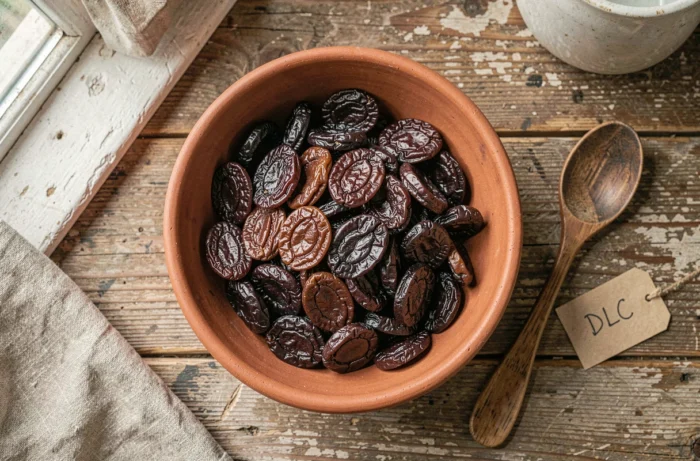
The shelf life of a prune depends primarily on its product category. A whole dried prune, a pitted prune, and a semi-dried prune do not have the same water activity or the same microbiological risks. Confusing these three references amounts to applying a single best-before date to very different stability profiles.
Water Activity and Critical Thresholds According to the Type of Prune
The parameter that governs the preservation of a dried fruit is water activity (aw). The lower the aw, the more hostile the environment is to molds and osmophilic yeasts. The industrial drying of the Ente plum aims for an aw sufficiently low to block fungal proliferation, but this value rises as soon as the product absorbs moisture again.
We recommend reasoning by category, as the indicative durations vary significantly:
- Whole dried prunes: 18 to 24 months in airtight packaging, stored between 15 and 20 °C. The intact skin limits the exchange surface with the ambient air.
- Pitted prunes: 12 to 18 months under the same conditions. Pitting opens the flesh, which increases the surface exposed to oxidation and facilitates moisture absorption.
- Semi-dried prunes: 9 to 12 months, with cooler storage (0 to 10 °C) after opening. Their higher residual water content significantly shortens the safety window.
- Prune puree: only 6 to 9 months. The homogeneous texture promotes oxidation and contamination once the packaging is opened.
These benchmarks come from recently updated professional market documents used for stock management in the supply chain. Most consumer sheets simply mention “several months” without distinguishing these categories.
Knowing how long to store prunes therefore requires first checking whether the bag contains a dried, pitted, or semi-dried product.

Storage Temperature and Humidity: The Two Underestimated Variables
A dried prune stored at 15 °C in a ventilated cupboard does not age at the same rate as a prune forgotten in a kitchen drawer at 25 °C in summer. Every increase of 10 °C accelerates oxidation and browning reactions, significantly reducing shelf life.
Ambient humidity plays a symmetrical role. Beyond 65% relative humidity, non-airtight packaging allows the prune to reabsorb water. The aw rises, and the risk of mold development increases. In a kitchen open to a bathroom or in an oceanic climate, this threshold is quickly reached.
Store in the Fridge or at Room Temperature
The refrigerator (0 to 5 °C) extends the shelf life of all categories. For semi-dried prunes, we consider it mandatory after opening. For whole dried prunes, the fridge is not necessary as long as the cupboard remains cool and dry, but it remains the safest solution during summer.
A bag closed with a simple clip does not constitute airtight packaging. Transferring prunes to a glass jar with a seal or a vacuum bag significantly reduces moisture absorption and gas exchanges.
Signs of Deterioration: What to Inspect Before Consuming
The best-before date (DLUO) on the prune packaging is a quality date, not a food safety date. A moderate exceedance does not mean the product is dangerous. However, certain signals require discarding the batch without hesitation.
A whitish powdery film on the surface is not always mold. On dried prunes, it often consists of sugars crystallizing as they migrate to the surface. This phenomenon, common after prolonged storage, poses no risk. In contrast, a green, gray, or black fuzz, especially localized in the folds of the skin or at the site of the removed pit, indicates fungal development.
Elimination Criteria
- Sour or fermented smell: a sign of fermentation due to too high an aw.
- Sticky texture with liquid release: the flesh has exceeded the stage of simple softening.
- Presence of insects or larvae, particularly the dried fruit moth, recognizable by fine silky threads between the prunes.
- Abnormally sour or pungent taste in the mouth, even in the absence of visual signs.
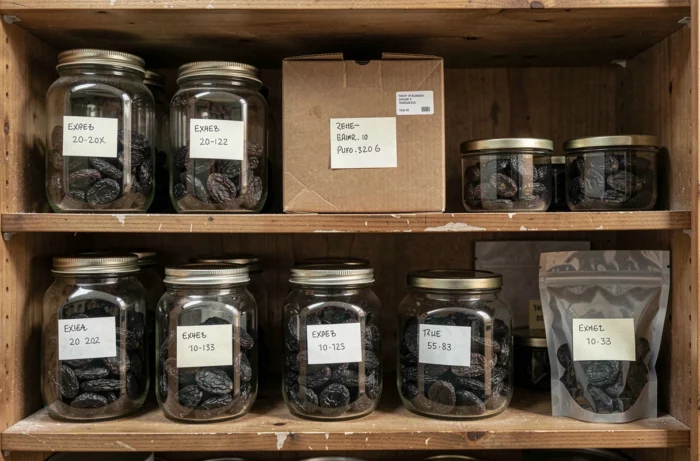
Long-Term Storage of Prunes: Freezing and Vacuum Sealing
Whole dried prunes freeze very well. A dried prune frozen at -18 °C can be stored well beyond two years without notable alteration of texture or flavor profile, as its low water content limits the formation of destructive ice crystals.
Vacuum sealing, whether combined with freezing or not, removes residual oxygen responsible for the rancidity of lipids present in small quantities in the flesh. For professionals managing volumes, this method is the standard for preservation between the reception of the batch and final packaging.
Organic Prunes: A Sometimes Shorter Shelf Life
The absence of certain post-harvest treatments on organic prunes can reduce their shelf life by a few months compared to conventional prunes. We observe that pitted organic batches are the most sensitive, as they combine exposed surface and absence of preservatives. Regular visual and olfactory checks are necessary starting from the sixth month after opening.
Storing prunes is not complex as long as the triptych is respected: airtight packaging, cool temperature, humidity control. A well-stored whole dried prune remains perfectly consumable for two years. An opened semi-dried prune left at room temperature can pose a problem within weeks. Adapting the level of vigilance to the type of product remains the only rule that matters.