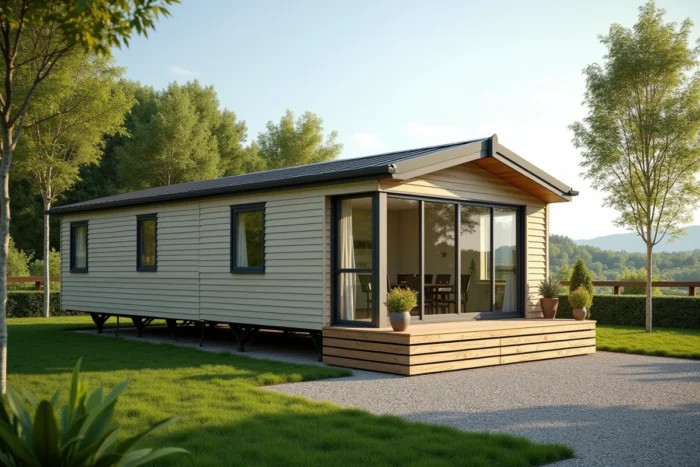
A mobile home placed on private land does not fall under the same legal framework as a house or a chalet. The urban planning code classifies it as a mobile leisure residence as long as it retains its wheels and towing bar. This classification determines where it can be parked, for how long, and under what conditions. Misunderstood, it exposes one to formal notices, financial penalties, or even a requirement to remove it.
Legal Qualification of the Mobile Home and Threshold for Reclassification
The status of the mobile home depends on a simple physical criterion: its actual mobility. As long as the chassis remains on wheels, the towing bar is in place, and the whole can be towed on the road, the urban planning code considers it a leisure vehicle, not a building.
The reclassification occurs as soon as the wheels are removed, the structure is placed on fixed supports, or it is permanently connected to utilities (water, electricity, sanitation). From that moment, the administration requalifies the mobile home as a light leisure dwelling (HLL) or as a building, depending on the area and use. This reclassification changes everything: the authorization regime, applicable taxes, and penalties in case of violation.
Understanding the installation of a mobile home on private land requires first addressing this status question, as the procedures directly stem from it.
PLU and Buildability: What the Plot Really Allows
Before any steps are taken, the local urban planning plan (PLU) of the municipality sets the rules of the game. A plot classified in zone U (urban) or AU (to be urbanized) can accommodate certain forms of light housing. A plot in zone A (agricultural) or N (natural) almost systematically prohibits it.
Zoning alone is not enough. The PLU regulations may impose additional constraints: maximum ground coverage, setbacks from property boundaries, height, external appearance. A buildable plot in a broad sense may very well prohibit mobile residences in its zoning regulations.
The Particular Case of STECAL
The ALUR law opened a theoretical possibility by allowing municipalities to create STECAL (sectors of limited size and capacity). These micro-zones, included in the PLU, can authorize removable residences as permanent housing, even on plots that are normally non-buildable.
In practice, the majority of recent PLUs do not open STECAL for mobile homes. Prefectures and urban planning services confirm that this provision remains marginal. Relying on a STECAL without having checked the PLU of one’s municipality amounts to betting on an exception that, in most areas, does not exist.
Urban Planning Authorizations Based on Duration and Area
The authorization regime varies according to two parameters: the duration of installation and the ground area.
- A temporary installation of less than three months per year on private land generally does not require any authorization, provided that the mobile home remains mobile and the PLU does not explicitly prohibit it.
- Beyond three months, or for year-round use, a prior declaration of works is required if the area remains less than or equal to forty square meters.
- Above forty square meters, a development permit becomes mandatory, with a heavier file including a site plan, descriptive notice, and sometimes a sanitation study.
- If the mobile home has been reclassified as a building (wheels removed, placed on a slab), the building permit threshold applies beyond twenty square meters of floor area.
In all cases, the first reflex remains to consult the urban planning department of the town hall. An operational urban planning certificate allows one to know, before any investment, if the project is feasible on the targeted plot.
Sanctions and Enhanced Controls on Non-Buildable Land
Installing a mobile home without authorization or on non-buildable land exposes one to graduated but real sanctions. The tightening of controls observed in recent years, particularly in coastal and peri-urban areas, has multiplied procedures.
The typical sequence begins with an infringement report drawn up by a sworn officer, followed by a formal notice to restore the site. If the owner does not comply within the allotted time, the court may impose daily financial penalties until the mobile home is effectively removed. Some cases are referred to the public prosecutor for violation of the urban planning code.
Zones A and N concentrate the majority of these procedures. A recent trend shows that municipalities increasingly systematically equate mobile homes placed in a garden with unauthorized constructions, even when the wheels are technically still present. The mere presence of connections to utilities is often enough to trigger reclassification.

Development Tax and Taxation of the Mobile Home on Private Land
A mobile home that remains mobile and temporary (less than three months) is generally not subject to property tax or development tax. The situation changes as soon as it becomes permanent or loses its mobility.
A mobile home reclassified as a building or declared as a removable residence for the year falls under the scope of the development tax, calculated on the enclosed and covered area. The housing tax on secondary residences may also apply if the mobile home is not the owner’s primary residence.
Failure to declare does not provide protection: in case of a control, the tax adjustment can cover several years, to which late penalties are added. Declaring one’s installation from the outset remains the only approach that avoids the accumulation of tax debts and administrative sanctions.
The regulatory framework for mobile homes on private land is based on a logic of thresholds: mobility, duration, area, zoning. Each threshold crossed triggers an additional obligation. Consulting the PLU and the municipal urban planning department, before any purchase of a plot or mobile home, remains the most reliable step to avoid a project that turns against its owner.